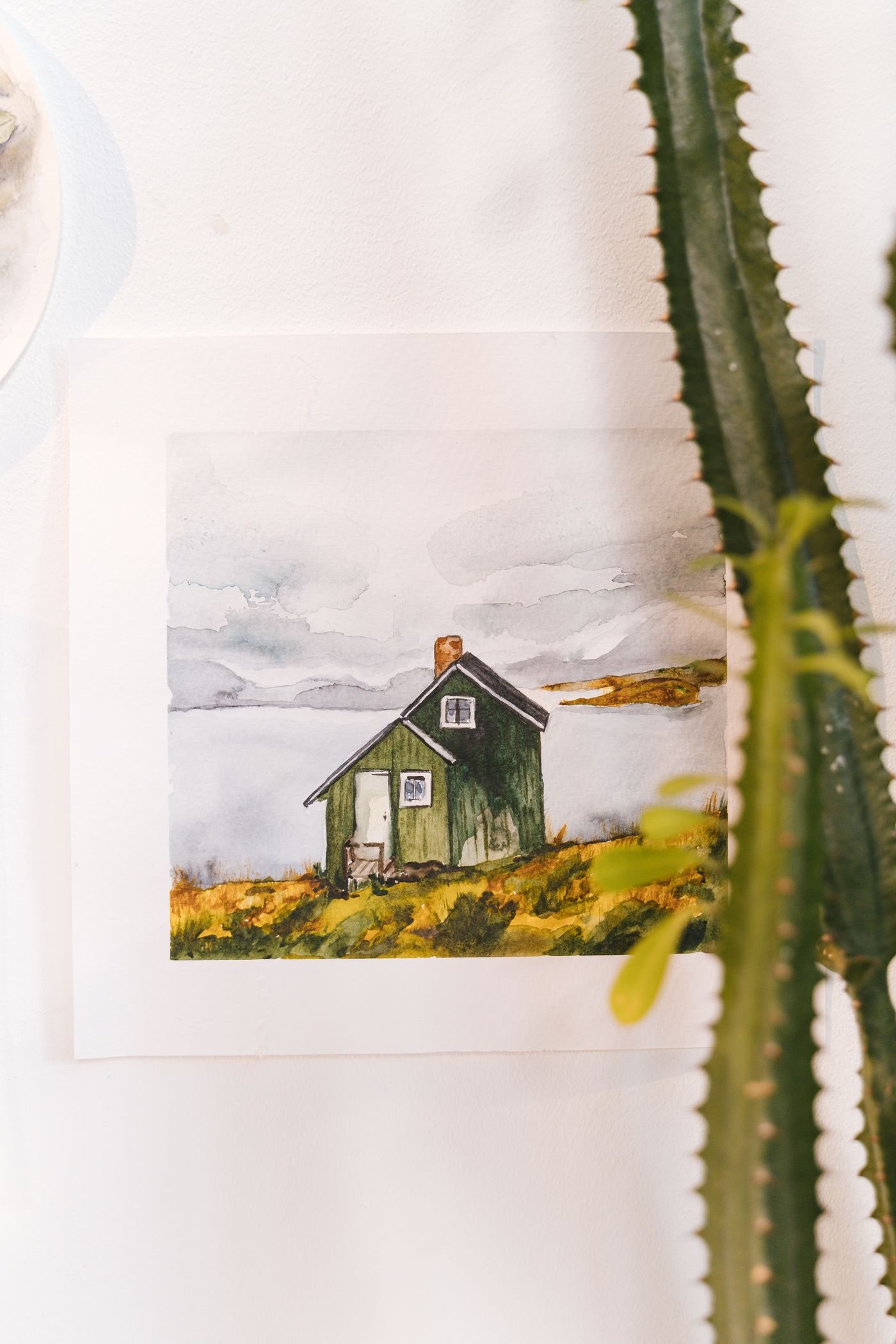
A house portrait can mark a first home, a childhood address or a place a family has recently left. The most meaningful version is not always a literal copy of a current street photograph. A particular door colour, an old climbing rose or the shape of a garden gate may be central to the memory. Decide which period and features the portrait should show before sending an artist a folder of mismatched photographs.
Establish the version of the house
If the building has changed, label photographs by approximate date and say which elements should be retained. You might want the present roofline with a former garden, but the artist needs that instruction explicitly. Mark any uncertain details rather than asking them to guess. For a surprise gift, family photographs can offer better references than a hurried image taken from the road. Avoid trespassing or photographing private interiors to obtain extra material. A slightly simplified view can still be recognisable when the important architectural features are clear.
Choose an angle with room to breathe
A straight-on view suits a symmetrical façade, while a corner view can reveal a familiar porch or side garden. Consider whether parked cars, bins and overhead wires belong in the finished image. Removing them may improve clarity, but stripping away every ordinary detail can make the house feel less like the place people remember. Tell the artist which features matter and let the rest support them. Ask to see comparable work so you understand how their style handles brickwork, foliage and perspective before commissioning your own piece.
Agree lettering and privacy
An address beneath the portrait can provide context, but it also makes the location explicit. The house name or a family phrase may be enough, particularly if the recipient might share a photograph of the gift online. Dates need a clear meaning: moving-in year, years spent there or the date of a milestone. Check whether any surname is still appropriate for everyone connected with the home. Keep the wording in a separate message that can be copied accurately, rather than embedding small handwritten instructions inside a reference image.
Finish it for the recipient's space
Confirm whether the commission includes a print, original artwork, mount or frame, and ask for the actual finished dimensions. A standard frame size can make later replacement simpler, but the mount opening must suit the art. Leave enough time for proofing, printing and framing rather than treating the artist's production estimate as the arrival date. If the gift concerns a home associated with loss or a difficult move, offer the choice of receiving it privately. The emotional setting matters as much as the frame colour.